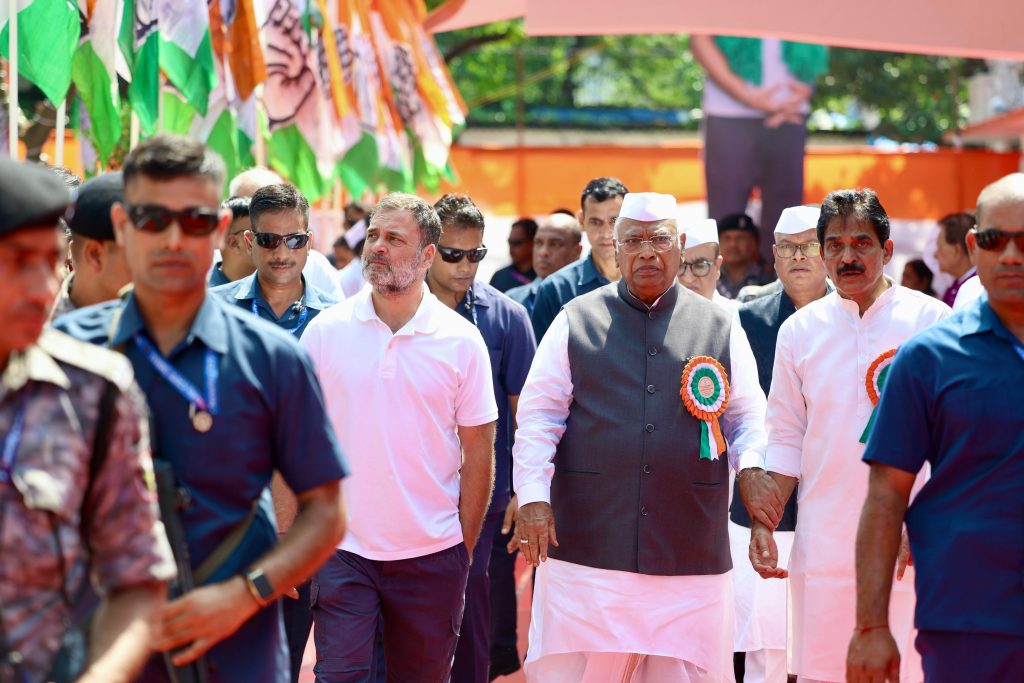
The Congress Working Committee (CWC) convened in Patna on Wednesday, marking a critical moment in the party’s positioning ahead of the Bihar elections. The resolution adopted at the meeting was not merely a critique of the ruling Bharatiya Janata Party (BJP) and its allies but a sweeping political indictment, connecting issues of governance, economy, social justice, and foreign policy under a single narrative of democratic erosion.
At its core, the resolution frames the Narendra Modi government as an authoritarian regime undermining India’s constitutional ethos.
The CWC accused the BJP-RSS of dismantling democratic institutions brick by brick, from weakening the Election Commission to weaponising investigative agencies. By terming the alleged manipulation of electoral rolls as “Vote Chori,” Congress sought to sharpen its attack on the government’s legitimacy, framing elections not as contests of policy but as battles for the survival of democracy itself.
Economic concerns formed a central pillar of the resolution. High unemployment, collapsing MSMEs, and persistent exam paper leaks were cited as symptoms of a system that privileges “crony friends” of the ruling elite while leaving the middle class, workers, and farmers adrift. The slashing of MGNREGA allocations and delayed GST compensation were held up as evidence of a government indifferent to India’s poorest citizens. In linking structural economic distress with the government’s alleged stepmotherly treatment of opposition-ruled states, the Congress attempted to fuse economic critique with federal anxieties.
On social cohesion, the resolution painted a grim picture of communal polarisation, systemic violence against Dalits and Adivasis, and the “mainstreaming” of the RSS. By invoking the prolonged crisis in Manipur and the Centre’s “complicity,” the party positioned itself as a voice for communities failed by the Union government’s silence.
Foreign policy was another sharp fault line. The CWC alleged that India’s strategic autonomy has been squandered—caught between US coercion under Donald Trump and Beijing’s assertiveness. References to Chinese territorial encroachments and rising import dependence dovetailed with concerns over India’s diplomatic isolation in the neighbourhood.
Beyond critique, the resolution carried emotional appeals: solidarity with victims of floods, grief over the passing of singer Zubeen Garg, and anguish over violence in Gaza. These insertions broadened the scope from partisan politics to moral positioning.
Ultimately, the Patna resolution reads as both an election document for Bihar and a national manifesto of resistance. By conflating constitutional defense with electoral urgency, Congress signaled its strategy: to portray 2025 not as another electoral cycle, but as a referendum on the Republic itself.