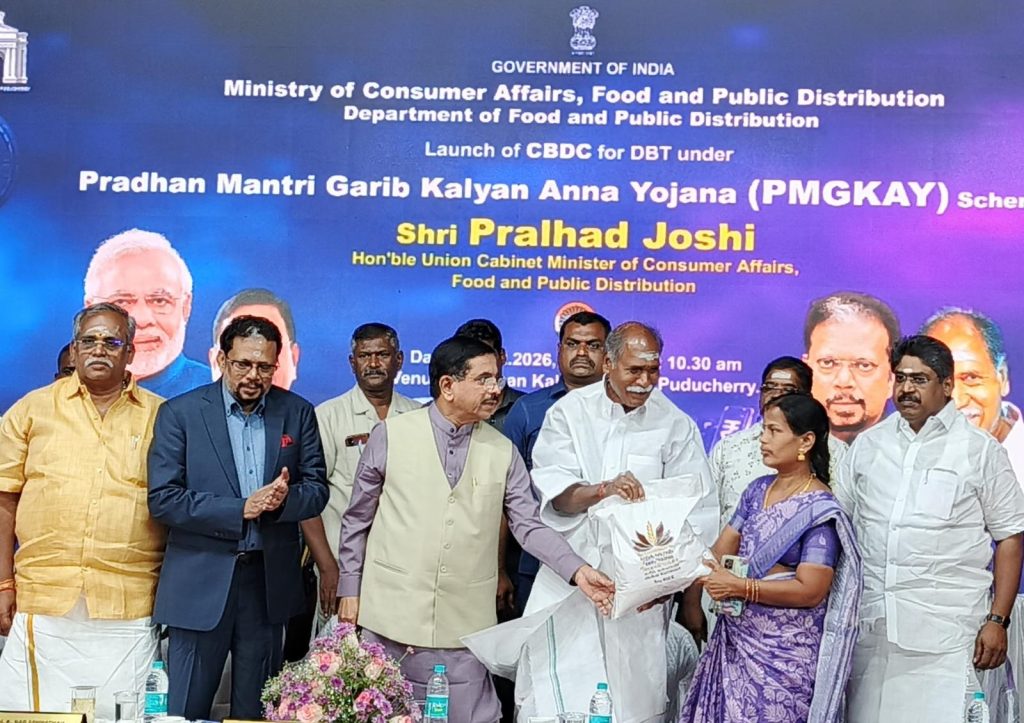
In a first-of-its-kind reform in India’s welfare architecture, the Centre has launched a Central Bank Digital Currency (CBDC)-based “Digital Food Currency” pilot project integrating the digital rupee into the Public Distribution System (PDS) when Union Minister for Consumer Affairs, Food and Public Distribution Pralhad Joshi inaugurated it.
Under the initiative, food subsidy will be credited directly to beneficiaries as programmable digital currency —issued by the Reserve Bank of India. These digital tokens, stored in CBDC wallets, can be redeemed exclusively for entitled food grains at Fair Price Shops and authorized merchants, ensuring purpose-bound use of subsidy funds.
Calling it a “transformative milestone” in India’s food security framework, Joshi said the integration of CBDC into PDS would enhance transparency, efficiency and accountability while empowering beneficiaries. “Every grain, every rupee, every entitlement,” he said, outlining the government’s vision to ensure that more than 80 crore beneficiaries receive their entitlements seamlessly.
Officials said the system addresses persistent challenges such as biometric authentication failures and e-POS connectivity issues by enabling secure, real-time and traceable transactions. The model also accommodates feature phone users, widening its accessibility.
PMGKAY, described by the Centre as the world’s largest food security programme, provides free foodgrains — including wheat, rice and millets — to eligible beneficiaries. According to the Minister, international assessments have recorded that nearly 25 crore people have moved out of multidimensional poverty over the past decade, aided in part by sustained welfare interventions. Surveys, he added, indicate that household food expenditure has declined significantly due to free grain distribution, allowing families to redirect savings towards milk, vegetables and other nutritional needs.
The pilot builds upon India’s digital welfare backbone — the Jan Dhan-Aadhaar-Mobile (JAM) trinity — and follows years of digitisation reforms in food distribution. These include nationwide portability under One Nation One Ration Card (ONORC), Aadhaar-enabled e-POS systems, the Rightful Targeting Dashboard, supply-chain optimisation through Ann Chakra, and grievance redressal via Ann Sahayata.
With the digital rupee now entering ration shops, the government is positioning CBDC not merely as a financial innovation but as a governance tool — one that could redefine how subsidies are delivered at the last mile.