With the number of freebies for women and youth being offered by the ruling side, will the voters lap them up or opt for a change?
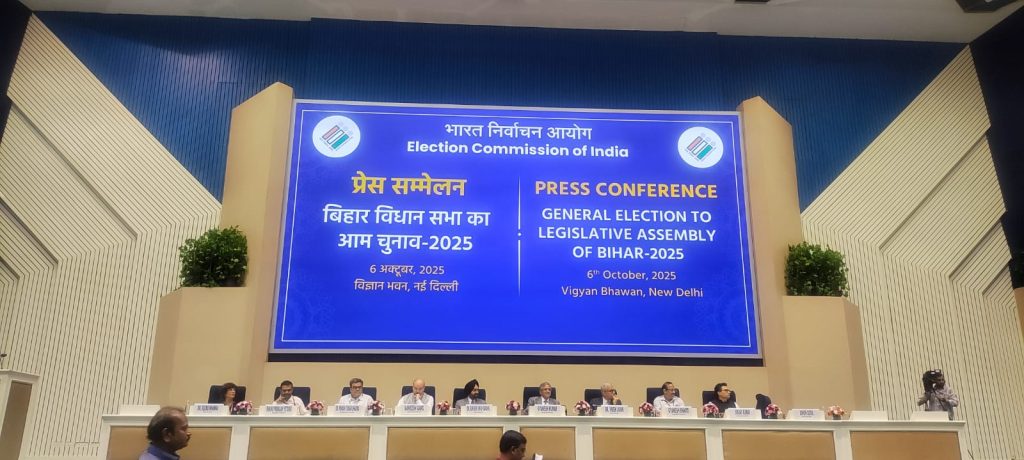
The Election Commission of India on Monday declared the schedule for the Bihar Assembly elections — a high-stakes contest featuring the ruling alliance of the Bharatiya Janata Party (BJP) and Chief Minister Nitish Kumar’s Janata Dal (United), facing off against the opposition coalition Mahagathbandhan, led by the Rashtriya Janata Dal (RJD) and the Indian National Congress and a third player in the fray — the Jan Suraj Party, founded by political strategist-turned-politician Prashant Kishor, which is positioning itself as a credible alternative. Other prominent parties in the mix include the All India Majlis-e-Ittehadul Muslimeen (AIMIM) and the Bahujan Samaj Party (BSP).
The election will be held in two phases, on November 6 and 11, with the counting of votes set for November 14. The final date for submitting nominations is October 17 for the first phase and October 20 for the second phase. Eligible voters can still enroll until the last date of nomination.
The term of the current 243-member Bihar Assembly is scheduled to end in November.
Last month, the Election Commission published the final electoral roll for the upcoming election. As of September 30, the total number of eligible voters in the state stands at around 7.42 crore, which includes 14 lakh first-time voters. Of the total electorate, 3.92 crore are male and 3.5 crore are female. The list also records 1,725 transgender voters, around 7 lakh individuals with disabilities, and 4 lakh senior citizens aged above 85.
In the 2020 Assembly elections, the National Democratic Alliance (NDA) secured a majority with 125 seats, while the Mahagathbandhan won 110. The RJD emerged as the single largest party, winning 75 seats. As it stands, the NDA controls 131 seats in the 243-member Assembly, while the opposition INDIA bloc holds 111 — with the RJD having 77, the Congress 19, and CPI(ML) 15.
Interesting possibilities
This year’s elections open up several intriguing possibilities. With the number of freebies for women and youth being offered by the ruling side, will the voters lap them up or opt for a change? Is RJD’s Tejashwi Yadav the option people of Bihar are looking for or will Prashant Kishor prove to be the dark horse in the race to the Bihar Assembly.
The entry of the Jan Suraj Party adds another layer of unpredictability, particularly in constituencies where voter dissatisfaction with both major alliances is growing. Prashant Kishor’s campaign, emphasising governance reform and grassroots engagement, may appeal to younger and first-time voters — a group that has expanded significantly since the last polls.
There are other issues — jobs, migration, shifting caste dynamics, and the fragmentation of traditional vote banks — that may lead to surprises in key regions, especially in areas like Seemanchal and Mithilanchal, where smaller parties like AIMIM and BSP have been gradually expanding their presence.
The INDIA bloc’s strategy will be tested, especially its ability to maintain unity and effectively transfer votes among allies. Meanwhile, the BJP-JD(U) alliance will have to counter anti-incumbency and manage voter perception amid leadership fatigue and concerns over development versus social justice.
Another key factor is voter turnout, particularly among women and youth, which could swing close contests. With rising political awareness, social media influence, and increasing engagement by civil society, Bihar’s electorate is more informed and vocal than ever. These elements together make the 2025 Bihar Assembly elections one of the most closely watched and potentially transformative in recent memory.