A new report by the Association for Democratic Reforms (ADR) and Bihar Election Watch has revealed alarming levels of criminal and financial influence among candidates contesting the Bihar Assembly Elections 2025 Phase I. The analysis, based on self-sworn affidavits of 1,303 out of 1,314 candidates, shows that nearly one-third of all contestants have criminal cases pending against them.
According to the report, 423 candidates (32%) have declared criminal cases, while 354 (27%) face serious criminal charges. These include 33 accused of murder and 86 of attempted murder. Additionally, 42 candidates face charges related to crimes against women, including two accused of rape.
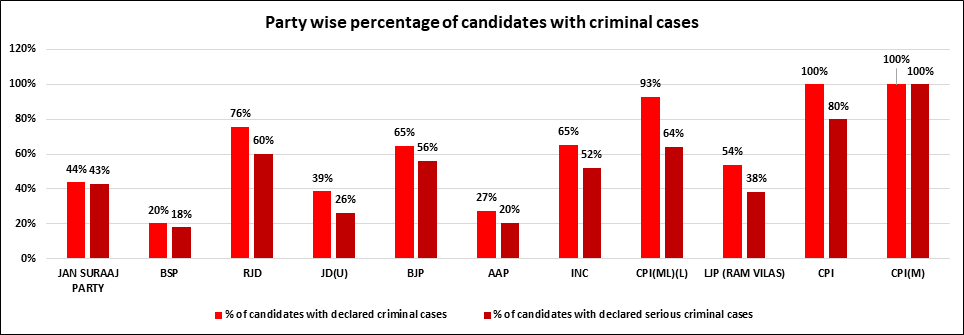
Among political parties, the Rashtriya Janata Dal (RJD) and the Communist Party of India (Marxist) have the highest proportions of candidates with criminal backgrounds—76% and 100%, respectively. The BJP (65%), JD(U) (39%), and Jan Suraaj Party (44%) also feature prominently. A staggering 91 out of 121 constituencies (75%) have been classified as “red alert” constituencies, where three or more candidates face criminal cases.
ADR noted that the Supreme Court’s 2020 directive urging parties to explain the selection of candidates with criminal antecedents “has had no visible impact.” The report criticized parties for citing vague reasons like popularity or political motivation instead of genuine qualifications.

Financially, the report highlights the growing role of money in Bihar’s electoral politics. As many as 519 candidates (40%) are crorepatis, with an average asset value of Rs 3.26 crore per candidate. The BJP tops the list with an average of Rs 11.3 crore, followed by the RJD (Rs 10.37 crore) and JD(U) (Rs 8.75 crore).
The richest candidate is Kumar Pranay of the BJP from Munger, who declared assets worth over Rs 170 crore, followed by Raj Kishor Gupta (Independent) with Rs 137 crore, and Anant Kumar Singh (JD-U) with Rs 100 crore. At the other end of the spectrum, some candidates, including Mojahid Alam of SUCI(C), declared assets as low as Rs 1,000.
In education, 50% of candidates are graduates or above, while 9% are women. The majority (51%) fall within the 41–60 age group.
ADR has called for stronger reforms, including permanent disqualification of candidates convicted of heinous crimes, disallowing those with serious charges, and stricter enforcement of Supreme Court guidelines. It also urged the Election Commission of India to ensure public display of candidates’ criminal and financial details at polling booths.
The findings, ADR warned, reflect an entrenched nexus of money and muscle power in Bihar’s politics—one that continues to threaten the integrity of democratic elections.