Amid voter roll revision controversy, the state gears up for a crucial assembly election where CM Nitish Kumar and challenger Tejashwi Yadav square off, with Prashant Kishor looming as a wildcard. A report by Tehelka Bureau
The political temperature in Bihar is rising rapidly as the state braces for another high-stakes assembly election. The Election Commission of India (ECI)has announced it will visit Bihar on October 4 and 5 to assess preparations for the upcoming polls. With the tenure of the current Bihar Legislative Assembly set to expire on November 22, the Commission will need to conduct the election before that date to ensure a seamless transition of power and formation of a new government.
A high-powered delegation of the Election Commission, led by Chief Election Commissioner Gyanesh Kumar, will be touring the state shortly. The visit is not merely a formality—it signals the beginning of the electoral countdown. Political parties, administrative machinery, and voters alike are bracing themselves for a battle that could reshape Bihar’s political landscape for the next five years.
In a significant move, Bihar became the first state in India to implement the Special Intensive Revision (SIR) of electoral rolls, ordered by the Election Commission as a nationwide exercise on June 24. While the ECI intended this as a broader reform across India, Bihar—being an election-bound state—was the first to put the directive into practice. This decision has not only brought attention to the voter roll revision process but has also triggered a fresh political debate about voter rights, data integrity, and transparency.
Unlike routine revisions that involve minor corrections, the SIR process required all registered voters in Bihar to submit fresh forms to remain on the draft list. This exercise, essentially a complete re-verification of the electorate, involved all 78.9 million existing voters. After completion, the draft list published on August 1 showed only 72.4 million voters, leading to the removal of nearly 6.5 million names. These deletions were attributed to voters who had died, relocated, were registered in other constituencies, or failed to verify their details. This marked the most thorough overhaul of electoral rolls in Bihar since 2003, when voters were last required to submit complete documentation to confirm eligibility and citizenship.
The last assembly elections in Bihar, held in 2020, occurred in the shadow of the COVID-19 pandemic. This time, while public health may no longer be a pressing concern, the election process is being shaped by new standards of verification and digitisation. The implementation of SIR has introduced a new paradigm of electoral scrutiny, making Bihar the first testing ground for what could become a national standard in future elections.
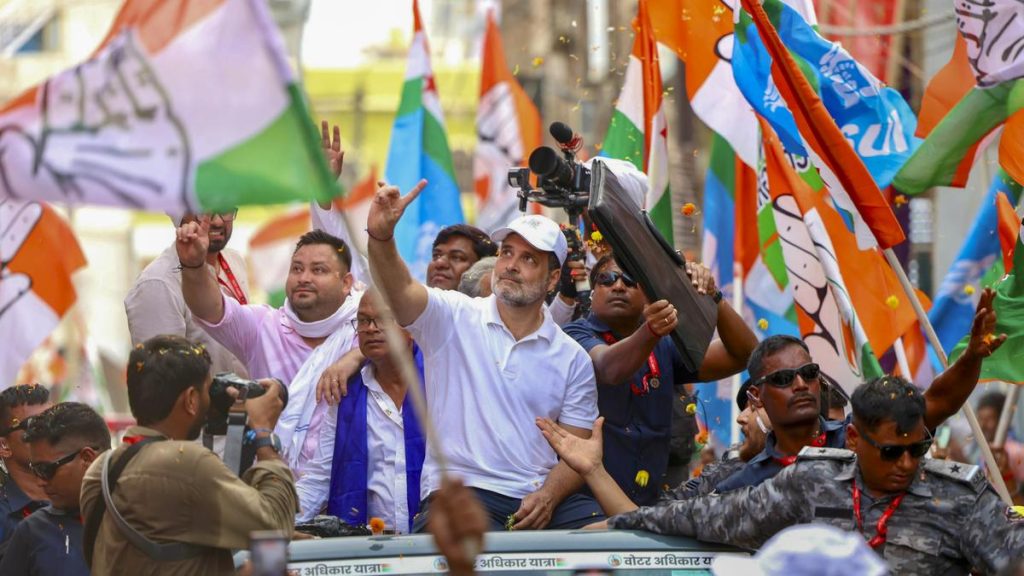
In the Bihar election campaign, Prime Minister Narendra Modi turned the spotlight on an emotional narrative, accusing the Congress of humiliating his mother and making it a central issue to sway public sentiment. However, the Leader of Opposition Rahul Gandhi complicated the battle by forcefully opposing the SIR policy and energizing his base through a high-profile padyatra across key constituencies. As both leaders sharpened their contrasting appeals—Modi with a personal, emotive touch and Gandhi with direct, street-level mobilization—the ultimate question of whose strategy resonates more deeply with voters will only be answered on polling day.
As the poll season begins in earnest, political temperatures are rising. The 2025 Bihar Assembly Electionsare shaping up to be a crucial contest that will determine who governs the state for the next five years. Two recent surveys—Lok PollandS India—have added further fuel to the political fire by releasing projections that hint at a close and unpredictable contest.
According to the Lok Poll survey, the Grand Alliance—led by the Rashtriya Janata Dal (RJD)and supported by the Congress and Left parties—is projected to win between 118 and 126 seats. The NDA, comprising the BJP, JD(U), and other allies, is projected to secure 105 to 114 seats. With the halfway mark set at 122 seats in the 243-member Bihar Assembly, the Grand Alliance appears to be within striking distance of a majority. The survey also estimates the Grand Alliance’s vote share to be between 39% and 42%, while the NDA is expected to garner 38% to 41%. The difference may seem slim, but in Bihar’s fragmented electoral terrain, even a 1–2% swing can have outsized effects on seat tallies.
Meanwhile, the S India Survey provides a regional breakdown that paints a more nuanced picture. In Purnia, where Muslim voters influence 24 key seats, the Grand Alliance is seen gaining ground. In Magadh, the NDA is expected to improve its previous performance across 26 seats, while the Grand Alliance may face resistance. Bhojpur appears to remain a stronghold for the NDA, with the party likely to hold its 22 seats. In Bhagalpur, both alliances seem evenly poised, but there are early signs of Jan Suraj’s growing influence—a factor that could disrupt established equations.
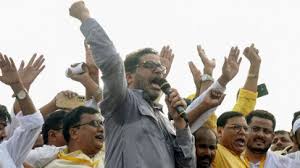
The Jan Suraj Party, led by political strategist-turned-activist Prashant Kishor, is emerging as a wildcard in this election. Though it may not win a large number of seats, its presence could impact outcomes in tightly contested constituencies. Kishor’s movement, which has focused on grassroots outreach and governance reform, is being watched closely. Even a modest increase in vote share for Jan Suraj could affect the calculations of both major alliances, particularly in seats where margins are traditionally narrow. While the Lok Poll indicates a lead for the Grand Alliance and the S India survey highlights areas of NDA strength, both agree on one thing—the 2025 Bihar elections will be a tight and closely fought contest. With alliances delicately balanced and smaller parties poised to play a spoiler role, every single seat will matter.
Amid all this, controversy surrounding the Special Intensive Revision refuses to die down. What was intended as a transparency-enhancing exercise has now turned into a political flashpoint. The mass deletion of names from the voter rolls—just months before the election—has raised serious concerns about disenfranchisement, especially among marginalised communities.
The issue reached the Supreme Court, where petitioners alleged that lakhs of voters have been wrongfully removed. The Court, while refusing to stay the process, acknowledged the seriousness of the concerns. It observed that the ECI had listed 11 acceptable documents for voter verification, and recommended that essential IDs such as Aadhaar cards, EPIC cards, and ration cards be included in the list. However, the Court left it to the Commission to decide how to proceed. The key takeaway from the proceedings was this: the ECI must act to allay fears of large-scale deletion of genuine voters and must work transparently to restore faith in the system.
This controversy has cast a shadow on the ECI’s role. While the Commission is constitutionally mandated to remain neutral and independent, it now finds itself embroiled in defensive posturing, legal disputes, and public criticism. In recent times, the ECI has been more visible in the news for issuing rebuttals and demanding affidavits from political parties than for quietly ensuring free and fair elections. As the credibility of the institution comes under scrutiny, many observers are reminded of a timeless warning: an institution’s strength lies in its integrity, not its authority.
The former Deputy Prime Minister Devi Lal once said, “Lok raj, lok laj se chalta hai”—meaning, democracy functions not only through power but through public respect. That sentiment seems particularly relevant now. Institutions like the Election Commission must command trust, not demand it. It must be open to scrutiny, especially when its decisions affect the fundamental right to vote.
What was initially described as a “cleansing” of the electoral rolls has now become a storm over voter rights, legality, and fairness. The debate has already reached the national stage, and depending on how it evolves, it could have long-term implications for electoral reforms across India.
With the official campaign season just around the corner, Bihar is preparing for a politically charged few weeks. Nitish Kumar, seeking to extend his long political innings, faces a resurgent Tejashwi Yadav, who is aiming to convert youth energy and anti-incumbency into a winning mandate. Prashant Kishor, still an unknown electoral quantity, is working hard to break the binary and establish a third way in Bihar’s traditional two-coalition model.
The stakes are high. The mandate of the people will not only determine who forms the next government but will also reflect how Bihar’s citizens view questions of trust, transparency, and governance. As the Election Commission finalises the dates and the campaign machinery begins to roar to life, one thing is clear: this will be one of the most consequential elections Bihar has witnessed in decades.