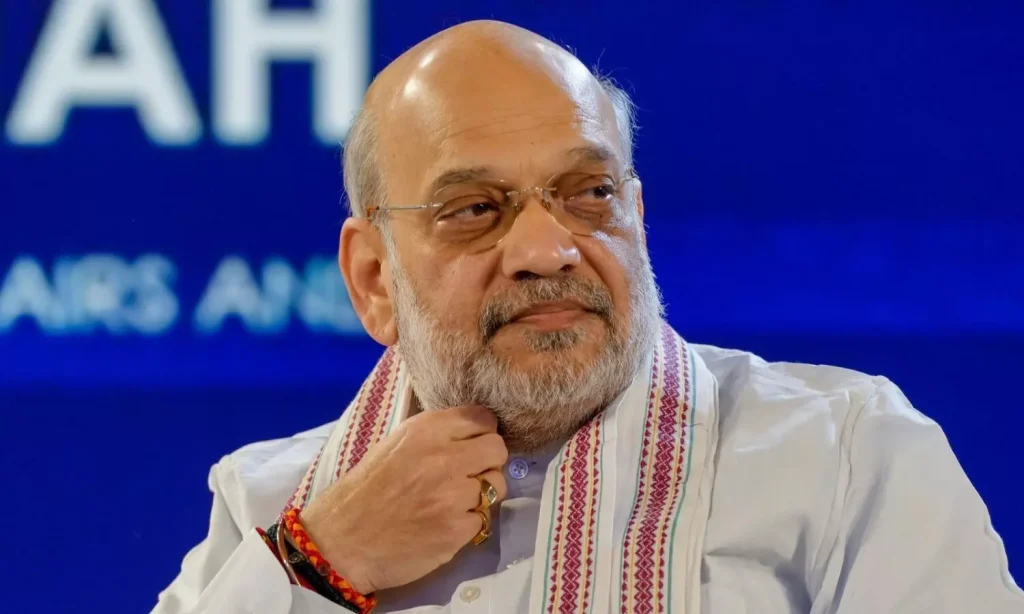
The main focus of Amit Shah’s visit is to concentrate on the party’s organisational strengths and weaknesses, and stocktaking of West Bengal’s organisational activities is a key part of this visit. Amit Shah knows the strengths and weaknesses of the organisation. That is why this time he is meeting organisational leaders at different levels. He is listening to the party’s opinions and complaints. He is directly receiving input through this feedback method from district-level and other entities, in addition to office bearers. He places a high priority on bolstering the organisation’s campaign apparatus.
He is emphasising the Motua vote bank. The SIR has caused a great deal of misunderstanding in relation to Motua votes. The TMC is running a campaign claiming that the Motua community feels uneasy because of the SIR. For this reason, Amit Shah stated that there is no insecurity in the Motua community during a press conference. Fear does not exist. This guarantee has been provided by Amit Shah. He even mockingly stated that Mamata Banerjee is unable to win the Motua votes, despite her desire to do so. For the party organisation to run its campaign along these lines, Amit Shah has developed this narrative. This is particularly crucial because Minister Shantanu Thakur and TMC member Mamata Bala Thakur are fighting in the Motua region. In areas governed by Motua, there is a great deal of political rivalry and jealousy.
What will be the primary focus of the BJP’s campaign? Topics such as Hinduism, appeasing Muslims, the BJP’s Hindutva agenda, and Mamata Banerjee’s use of religious symbols and temple building. The issue is how to counter the notion of appeasing Muslims.
Infiltration is one problem in the SIR electoral process, but there is also an ongoing infiltration campaign. For the BJP, infiltration is not a novel problem. Since the RSS’s founding, infiltration has been a crucial problem that they have used to further their goals. They hope to use the SIR to communicate their desire for West Bengal’s population to be free of infiltrators in the future. The question being posed is how to create a big deal out of the infiltration problem during elections, aside from the administrative aspect of voter lists.
Amit Shah is meeting with Bengali RSS leaders to coordinate this time. He is expected to visit the RSS headquarters in Bengal, Keshab Bhavan. There, he hopes to demonstrate that the RSS and the BJP are working together. In order for them to collaborate successfully at the district level, he wants to show that there are no coordination gaps.
Amit Shah is at ISKCON. He is visiting Sister Nivedita’s home as well. Mamata Banerjee recently went to both of these locations. In addition to pulling the ISKCON chariot, Mamata Banerjee helped build the Jagannath Temple in Digha through ISKCON. For this reason, on December 5, Mamata Banerjee visited Nivedita’s home, where she intervened and fixed a number of site-related problems. For this reason, Amit Shah has prioritised Sister Nivedita this time in addition to Belur Math and Swamiji’s home.
Amit Shah is also facing a significant problem in this Mission Bengal, which might be characterised as a leadership crisis. An organisational crisis can also exist. The BJP may need to engage the public directly to resolve this organisational issue.
There are splits and organisations within the BJP. There are miscommunications within the party as well as rivalry between its leaders and organisations. Amit Shah has personally come to fix these problems. In order for the party to advance together, he is working to resolve these problems.
Corruption is another important issue. Amit Shah hosted a news conference in Kolkata this time. He brought up the subject of corruption throughout this thorough press conference. He listed the names of TMC ministers, MLAs, MPs, and politicians who had been imprisoned on corruption accusations. He is advising the state unit of the BJP to turn the corruption issue into a significant campaign.
The BJP aims to convey that it envisions a new Bengal—a peaceful, development-oriented West Bengal free of corruption. State leaders were advised by Amit Shah on how to counter Mamata Banerjee’s claims about land acquisition and the BSF’s involvement. He claimed that because Mamata Banerjee is not supplying land, border management and related problems are still unsolved. As a result, the state government is accountable. Regarding development, he stated that although the federal government is prepared to supply finances, the state governments are not making appropriate use of them. Funds are not being released or used because of widespread corruption.
He released a statement in Bengali, which was also shared on X Post. Amit Shah spoke to the crowd in Bengali for the first time. Thus, there is an ongoing campaign on how Delhi will take over Bengal, which is part of the Bangla and Bengali territory, and Delhi is attempting to subjugate that location. Amit Shah concentrated on Rabindranath Tagore, Bankim Chandra Chattopadhyay, and all the other Bengali giants throughout his press conference since they do not comprehend Bengali identity. He emphasised that Mamata’s strength is Bengali DNA and offered guidance on developing Bengali leadership. These are Amit Shah’s recommendations.
However, it is still unclear if the BJP has the organisational capacity necessary to carry out this recommendation. Is it possible for the BJP to construct such a campaign, counter-campaign, and counter-narrative? Additionally, the BJP was still unable to advance into Bengal. For this reason, Amit Shah tried to fully activate the Bengal Mission by travelling to Bengal on his own initiative.