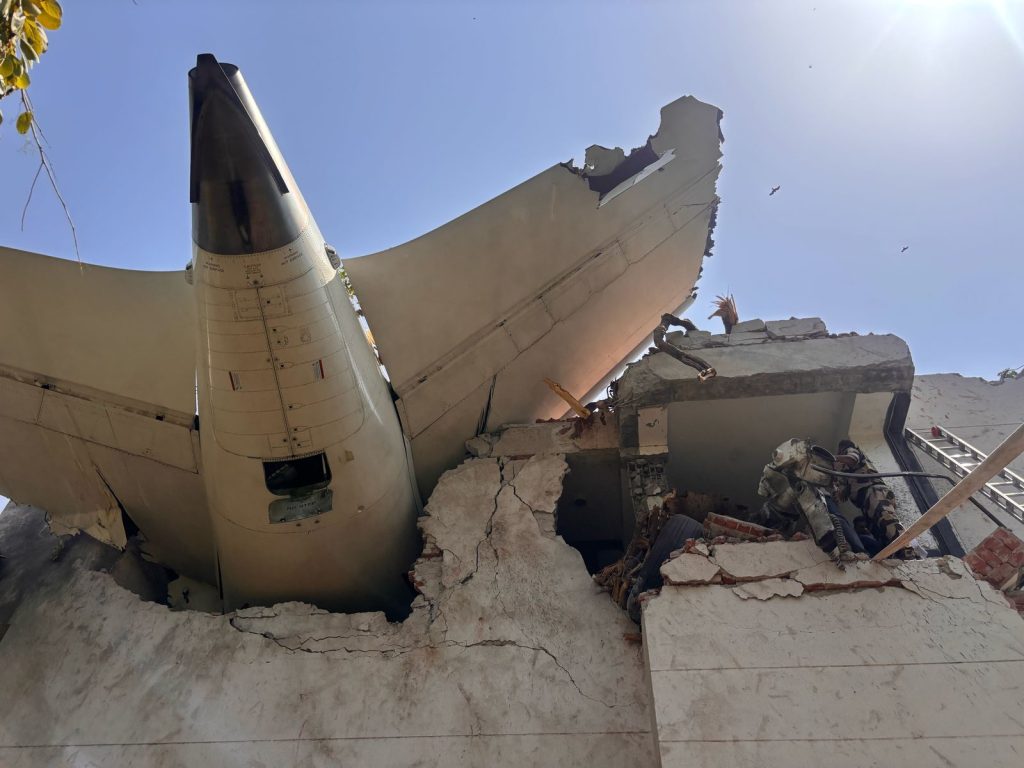
In its preliminary report based on the preliminary facts and evidence collected during the investigation, the Aircraft Accident Investigation Bureau (AAIB) has suggested a series of possibilities which led to the crash of Air India Flight 171, a Boeing 787-8 Dreamliner.
According to data extracted from the aircraft’s Enhanced Airborne Flight Recorder (EAFR), commonly referred to as the black box, Flight 171 carried out a routine takeoff.
The Dreamliner accelerated to a takeoff speed of 153 knots and then reached a maximum airspeed of 180 knots, climbing steadily as expected.
“The flap setting was recorded at five degrees, and the landing gear lever remained in the ‘DOWN’ position, both standard takeoff procedures. Within seconds, the fuel control switches for Engine 1 and Engine 2 transitioned from the “RUN” to “CUTOFF” position, one after the other, within a one-second interval,” the report stated.
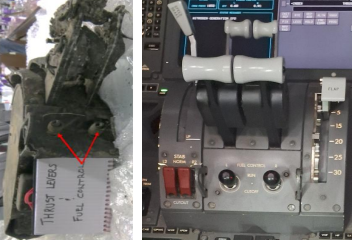
The Engine N1 and N2 began to decrease from their take-off values as the fuel supply to the engines was cut off. In the cockpit voice recording, one of the pilots is heard asking the other “why did you cutoff?” The other pilot responded, “I did not do it.”
These switches govern the flow of fuel to the engines, and their transition to “CUTOFF” halted the supply, causing both engines to lose thrust. The black box data shows that thrust levels began to decrease from their takeoff values almost immediately, triggering a rapid de-throttling process.
“The CCTV footage obtained from the airport showed Ram Air Turbine (RAT) getting deployed during the initial climb immediately after lift-off. No significant bird activity is observed in the vicinity of the flight path. The aircraft started to lose altitude before crossing the airport perimeter wall,” the report said.
The switches for Engine 1 and Engine 2 are spaced approximately two to three inches apart, making it improbable for both to be moved simultaneously without intent.
The report suggests that pilot moved swiftly and turn the fuel control switches back to the “RUN” resulting in Engine 1 responding and its core speed deceleration halted, reversed, and began to recover, with thrust levels rising. Engine 2 also relit, but its core speed continued to decelerate despite repeated attempts to reintroduce fuel and accelerate recovery.
At 1:39:32 pm, Flight 171 struck the hostel, sparking a fireball that devastated the site.
The incident happened when Air India Flight 171, a Boeing 787-8 Dreamliner, departed Ahmedabad’ s Sardar Vallabhbhai Patel International Airport at 1:39 pm, bound for London Gatwick. Within 32 seconds of takeoff, the aircraft crashed into a medical hostel near the airport, killing 241 of the 242 passengers and crew on board and 19 people on the ground.