By Tehelka Web Desk
SRINAGAR, SEP 8: There was a time when going to the cinema was part of everyday life in Kashmir. Srinagar had more than a dozen theatres, with names such as Regal, Palladium, Neelam, Naaz, Firdaus, Khayam and Sheraz woven into the city’s popular culture. Families went to watch Bollywood films, young people queued for their favourite stars, and the cinema hall was as much a part of urban life as the marketplace.
Today, almost none of those theatres exists as a functioning cinema.

That is the backdrop for Jammu and Kashmir’s first International Film Festival, a four-day event that brings filmmakers, cinematographers, producers, curators, and film educators from India and abroad to Srinagar. The festival, which began on September 7, is being presented as an attempt to reconnect Kashmir with the wider world of cinema and revive its identity as a destination for filmmakers and storytellers.
The irony is hard to miss.
Kashmir, once one of Bollywood’s favourite outdoor locations, today has just one functioning commercial cinema in the Valley — the INOX multiplex at Shivpora in Srinagar. Current listings show regular screenings there, while the other cinema halls that once dotted Srinagar have long since fallen silent.
The contrast is particularly striking because Kashmir’s relationship with Indian cinema predates the era of modern Bollywood tourism. From the romantic landscapes of Raj Kapoor’s Barsaat onwards, the Valley became part of the visual language of Hindi cinema. Its mountains, lakes, gardens and meadows provided filmmakers with a ready-made cinematic landscape.
For decades, Kashmir was where Bollywood went when it wanted to create romance.
Then came militancy.
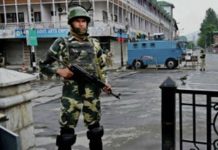
Cinema halls were among the early casualties of the conflict. A diktat by the militant group Allah Tigers led to the closure of theatres, and by the early 1990s all the Valley’s operational cinema halls had shut. Many of the abandoned buildings were subsequently occupied by security forces, while others deteriorated or were converted to other uses.
There were attempts to bring them back.
Regal, Neelam and Broadway reopened in the mid-1990s, but the experiment did not last. In 1999, militants attacked Regal during a show, killing a moviegoer and injuring others. Neelam survived longer, but a militant attack in 2005, when people were watching Mangal Pandey: The Rising, further damaged the already fragile cinema culture. Neelam eventually closed in 2010.
As theatres disappeared, Kashmir also disappeared from Bollywood’s production map.
Filmmakers who had once travelled to the Valley increasingly looked elsewhere. Switzerland, in particular, became the favoured substitute for the sweeping romantic landscapes that Kashmir had once supplied so effortlessly. The change was not simply about geography; it reflected the extent to which conflict had altered the relationship between the Valley and the Hindi film industry.
Yet the camera never completely abandoned Kashmir.
Over the years, filmmakers returned, sometimes cautiously, to shoot films in the Valley. Haider, Rockstar, Jab Tak Hai Jaan and Laal Singh Chaddha are among the more prominent films to use Kashmir as a setting, suggesting that the landscape retained its cinematic pull even when its theatres had disappeared.
Omar Abdullah invoked that history while speaking at the opening of the film festival in Srinagar on Monday, recalling a time when Kashmir was the preferred destination for filmmakers before Switzerland became synonymous with Bollywood romance.
The Chief Minister also spoke about the personal place that old Hindi cinema continues to occupy in his life.
“Some of my favourite songs, part of multiple playlists from my home, just happened to be filmed in Kashmir. Whether it’s Kabhie Kabhie Mere Dil Mein or Sanjeev Kumar and Suchitra Sen at Markan Temple, with Tere Bina Zindagi Se from Andhi, probably one of my old-time favourites.”
He also recalled that one of Rishi Kapoor’s songs remains a family favourite.
The festival itself is an attempt to turn that nostalgia into something more contemporary.
The inaugural edition has brought together an international jury including cinematographer Santosh Sivan, German filmmaker and curator Dorothee Wenner, Japanese media entrepreneur and documentary filmmaker Keiko Bang, and National Film Award-winning filmmaker and educator Himansu Sekhar Khatua. Director-producer Ramesh Sippy and Kashmir-born filmmaker Vidhu Vinod Chopra are among the special guests.
The festival is being organised by the Jammu and Kashmir Department of Information and Public Relations and is designed around cinematic excellence, cultural exchange and international participation. Its organisers hope the event will help position Jammu and Kashmir once again as a destination for filmmakers, artists, storytellers and audiences.
But the most powerful symbol of the festival may be just outside its programme.
For a place that once had a cinema hall on almost every important street of Srinagar, there is now only one commercial screen in the Valley.
That makes the festival more than a celebration of films. It is also a reminder of what Kashmir lost.
For generations of Kashmiris, cinema was experienced not on a phone or television screen but collectively — in dark halls where hundreds of people laughed, cried, whistled and waited for the lights to come back on.
The festival is an attempt to bring some of that relationship back.
Whether it can do so beyond four days of screenings and celebrity appearances remains to be seen. But for a Valley whose cinema halls were once among the first public spaces to fall silent during the years of conflict, the return of filmmakers and film lovers to Srinagar carries a significance that goes well beyond the festival itself.